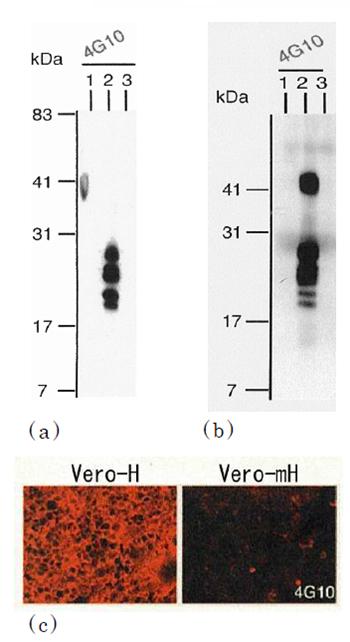
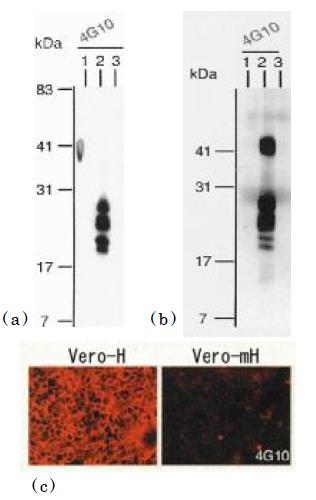
Description Heparin-binding epidermal growth factor-like growth factor (HB-EGF) is synthesized as a membrane-anchored precursor that is proteolytically cleaved to release the soluble mature growth factor, HB-EGF (1, 2). The former functions as juxtacrine and the latter as paracrine growth factor. Soluble HB-EGF shows several forms in Western blot with apparent molecular weights 19~27 kDa due to heterogeneous O-glycosylation and N-terminal truncation. HB-EGF activates EGFR and ErbB4 and promotes the development in many tissues. In human ProHB-EGF is the cellular receptor for diphtheria toxin (3). Non-toxic mutant of diphtheria toxin, CRM197, inhibits HB-EGF function. As HB-EGF level is elevated in most ovarian cancer, CRM197 is being tested as an anticancer drug (4). The hybridoma clone 4G10 was established and characterized in the laboratory of Prof. E. Mekada of Osaka University, who is a leading scientist in this field (3, 4). Applications The antibody can react with both soluble and cell-surface attached forms of HG-EGF. 1) Western blot 0.2~1 ug /ml 2) Immunoprecipitation (2 ug/ml) 3) Indirect immunofluorescence staining (5~10 ug/ml) Specification Antigen: Recombinant human HB-EGF ectodomain expressed in SF21 cell Antibody: Mouse monoclonal antibody produced in serum-free medium and purified by combination of chromatography Isotype: IgG1 (mouse) Epitope: EGF domain Reactivity: React with human, but not with mouse Form: 1 mg/ml in PBS, 50% glycerol, filter-sterilized, azide-free Storage: Ship at 4°C or -20°C, and upon arrival, aliquot and store at -20°C or below. Data Link: UniProtKB/Swiss-Prot Q99075 (HBEGF_HUMAN) References 1. Higashiyama S et al “A heparin-binding growth factor secreted by macrophage-like cells that is related to EGF” Science 251: 936-939 (1991) PMID: 1840698 2. Prenzel N et al “EGF receptor transactivation by G-protein-coupled receptors requires metalloproteinase cleavage of proHB-EGF” Nature 402: 884 -888 (1999) PMID: 10622253 3. Iwamoto R et al “Heparin-binding EGF-like growth factor, which acts as the diphtheria toxin receptor, forms a complex with membrane protein DRAP27/CD9, which up-regulates functional receptors and diphtheria toxin sensitivity” EMBO J 13: 2322-2330 (1994) PMID: 8194524 4. Miyamoto S et al “Heparin-binding EGF-like growth factor is a promising target for ovarian cancer therapy” Cancer Res 64:5720-5727 (2004) PMID: 15313912 Figures: Identification of human HB-EGF by using anti-HB-EGF 4G10 (a) Western blot Lane 1: Vero cell extract Lane 2: Vero cells carrying human HB-EGF expression vector Lane 3: Vero cells carrying mouse HB-EGF expression vector (b) Immunoprecipitation Lanes are the same as (a) except that the cell surface was biotinylated. After IP with the antibody, HRP-conjugated streptoavidin was used to detect the HB-EGF by WB. (c) Immunocytochemistry Samples; (Vero-H) Vero cells carrying human HG-EGF expression vector, (Vero-mH) Vero cells carrying mouse HB-EGF expression vector. Cells treated with antibody 4G10 were fixed with 4% PFA and reacted with Cys3 conjugated 2nd antibody.